From Minimum Living Income to asset seizure: a corruption whistleblower with a 65% disability rating denounces state persecution
A benefit she says she neither applied for nor authorised has become a debt of €8,872.40, a bank seizure and a threat of seizure of her assets. María José Alarcón, a public representative of Afectados BB Serveis, says the authorities intend to make her pay for their own errors, despite European case law protecting good-faith recipients against disproportionate recovery demands.
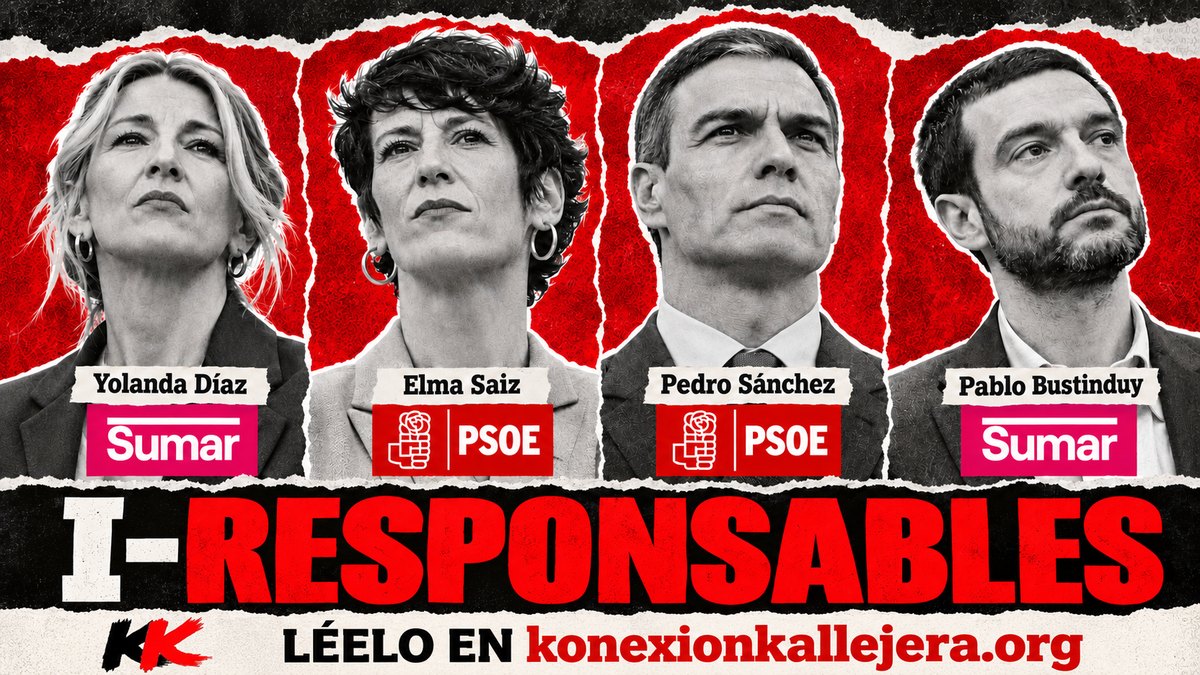
“We will call it mismanagement, because the alternative would be bad faith”
María José Alarcón and Robert Martinez, public representatives of Afectados BB Serveis, who have exposed what they describe as Spain’s biggest fraud in the social care sector, have made the following statement public:
“We will call it mismanagement, because the alternative would be bad faith. We want to believe that the current political officeholders — Pedro Sánchez (PSOE), Prime Minister; Elma Saiz (PSOE), Minister for Social Security and government spokesperson; Yolanda Díaz (Sumar), Second Deputy Prime Minister; Pablo Bustinduy (Sumar), Minister for Social Rights; and Raúl Moreno (PSC), Catalan Minister for Social Rights and Inclusion — are unaware of the extent of the harm these administrative actions are causing two people who have been reporting corruption for more than 15 years, one of whom, María José, has a recognised disability rating of 65%.
What is clear to us is that this will not end here. There will be a legal response to what we consider another attack on our rights. We will see this through and demand accountability from those responsible.
The state should offer particular protection to vulnerable people and those who have spent years reporting alleged corruption. Our experience, however, has been the opposite.
While the government that presents itself as the most progressive in history claims to defend the most vulnerable, we feel that we are experiencing administrative harassment, economic persecution and harm that will be extremely difficult to repair.
Social rights cannot be defended through speeches alone or by constantly appealing to the threat of the right or far right. They are defended through action, by guaranteeing rights and protecting those who most need it.
It is disturbing to see the force with which the machinery of the state is mobilised to reclaim money and seize the assets of vulnerable people, while for years we have denounced the lack of an equally effective response to those allegedly responsible for the BB Serveis criminal scheme.
We believe that this lack of action fosters impunity for those allegedly responsible and harms the victims once again.
We are not asking for privileges. We demand justice, protection and compliance with the law.”
Background to this case can be found in the article “New administrative harassment: recovery demands against vulnerable whistleblowers (BB Serveis)”, published by Kaos en la Red, and in Konexión Kallejera’s original video report on YouTube.
A benefit they say they never applied for
In May 2021, the Government of Catalonia sent the Spanish National Social Security Institute (INSS) the documentation to initiate an application for the Minimum Living Income (IMV).
This is not an assumption. The INSS itself acknowledges this in an official decision dated 19 February 2026.
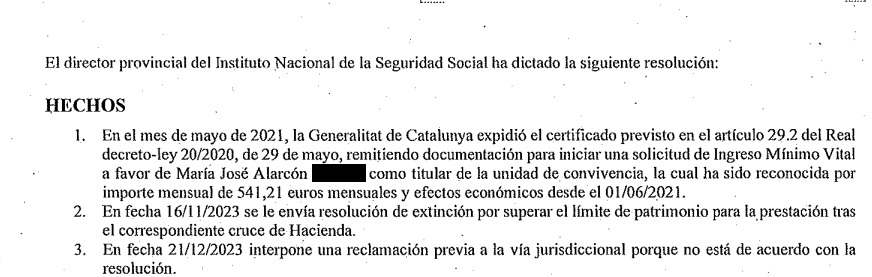
However, the claimants say they never consented to the procedure, despite the consent requirement under Article 29.2 of Royal Decree-Law 20/2020.
Where is the document proving that authorisation? Why should the claimants bear the financial consequences of a procedure they say they never authorised?
In November 2023, the INSS terminated the benefit retroactively to January of that year, alleging that certain asset thresholds had been exceeded. According to the claimants, the dispute concerns her half-share in a specially regulated protected-housing apartment where María José’s children and grandchild live, a valuation they contest.
The property is subject to legal restrictions on disposal and sale.
791 days to respond to a complaint
On 21 December 2023, a prior administrative complaint was filed against the INSS decision.
The response did not arrive until 19 February 2026, confirming the retroactive termination of the benefit and leaving open the recovery of alleged overpayments.
The claimants argue that those payments should not have resulted in a repayment obligation because the authorities knew from the outset about the half-share in the property and had the necessary information to assess their situation before granting the benefit.
791 calendar days of waiting, compared with a statutory response period of 45 days.
More than two years of uncertainty as the claimants tried to defend their rights against the administration.
From possible administrative errors to bank and asset seizures
Instead of resolving the situation, the General Treasury of Social Security initiated a collection procedure that has progressively escalated:
- July 2026: a demand for €7,349.90.
- September 2026: the debt increased to €8,819.88.
- November 2026: a demand to declare assets in proceedings aimed at their possible seizure for a debt of €8,872.40, accompanied by a warning about potential criminal consequences for certain forms of non-compliance.
- 27 November 2026: the first known bank hold of €5.49.
A benefit intended to fight poverty has resulted in a debt, surcharges, interest, bank seizures and the threat of asset seizure.
The claimants have taken the matter to court, challenging both the origin of the benefit and the validity of the repayment demand.
Who bears political responsibility?
The senior political officeholder at the Ministry for Inclusion, Social Security and Migration is Elma Saiz (PSOE), who also serves as government spokesperson.
Both the INSS and the General Treasury of Social Security are within her ministry’s structure. The Secretary of State for Social Security and Pensions is Borja Suárez Corujo.
In Catalonia, Raúl Moreno (PSC) currently heads the Department of Social Rights and Inclusion, which manages regional income-guarantee policies.
Political explanations can also be sought from Pedro Sánchez (PSOE) as Prime Minister and Yolanda Díaz and Pablo Bustinduy (Sumar) as members of the government responsible for labour and social rights, although their ministries do not oversee the INSS or the Treasury.
The officeholders named have different institutional and political responsibilities. There is no evidence that they personally participated in deciding this case, but they can be asked to explain the management of bodies and policies within their remit.
Can the administration make citizens pay for its own mistakes?
In its 2018 judgment Čakarević v. Croatia, the European Court of Human Rights established that demanding repayment of benefits granted through administrative error may violate the rights of people acting in good faith when it imposes a disproportionate financial burden.
The claimants believe that this principle must be examined in their case.
Their defence challenges, among other matters:
- The possible absence of consent to the IMV application.
- The asset valuation used to terminate the benefit.
- Insufficient reasons for the administrative decisions.
- The extraordinary delay in resolving the complaint.
- The proportionality of the debt, surcharges and seizures.
- The damage and losses caused by administrative actions.
The day of reflection: social rights cannot remain mere words
On the eve of the 29 November election, Konexión Kallejera wishes to highlight a reality that should concern society as a whole, regardless of political ideology.
Who protects vulnerable people when the public authorities themselves allegedly create or worsen their problems?
What protection is provided to people who report alleged corruption for years? What happens when, instead of feeling protected, they end up having to defend themselves against the institutions themselves?
Social rights should not depend on institutional speeches or political promises. They must translate into effective protection.
Konexión Kallejera publicly denounces a situation that calls for explanations, transparency, urgent review and, if the alleged irregularities are established, appropriate accountability.
We will continue documenting this case. Because reporting corruption and defending social rights should not become a punishment for those who dare to speak out.
Konexión Kallejera — The media outlet shining a light on stories others do not tell.
Share this article on social media
Facebook and LinkedIn: clicking copies the headline and link. Paste them into your post (Ctrl+V or long-press and Paste).